Monday, March 26, 2012

Who Says That You Need To Buy A Guitar?

The  above quip made to the camera in "It Might Get Loud" (2010) by Jack White still rings true as we see the aspirations of many emerging countries, that have wrought own traditional music from basic everyday objects.


African Music History

From the 15th C onwards, our history of music making in Africa is mainly derived from studying representations of dances and making music with African musical instruments and scenes depicted in terracotta, stone or metal.
In Ife, Yorubaland we see footed cylindrical drums dating from the 10th to 14th century on terracotta artefacts.
In Benin, pressure drums appear on brass plaques from the 15th C onwards. These plaques have proven to be a never-ending supply of information on the use of instruments like horns, bells, drums and bow lutes in ceremonial occasions.
In real form, the iron bells excavated in Katanga province, Congo and the Zambezi Valley of Zimbabwe are some of the earliest actual African musical instruments found, also dating around mid/late 15th C.
Kalangba xylophone

Kalangba xylophone, Tervuren museum

Migrations of tribes, movement of slaves and colonial porters and servants have all contributed to the wide dispersement of African musical instruments.
For example, lamellaphones with metal keys were a prominent feature in ancient Zimbabwe and spread through neighbouring kingdoms to Katanga and Angolan cultures, all the while becoming smaller and smaller for travelling purposes.
Zimbabwean 'mbiras' (lamellaphone) and 'ngomas' (drums) were first written about by Father Joao dos Santos, a Portuguese who travelled through the lower Zambezi in 1586 and recorded his impressions of the sounds these instruments made and the effects they had on their combined audience.
Historically, Africa has contributed hugely to music-making in many other areas of the world most notably the Americas and most significantly in genres such as jazz, rock and roll, blues, salsa and samba. Music once considered "primitive" by Westerners is now highly respected for its rhythmic sophistication and complexity.

Caribbean 
Musical History
The Origin of Calypso

Calypso rhythms can be traced back to the arrival of the first African slaves brought to work in the sugar plantations of Trinidad. Forbidden to talk to each other, and robbed of all links to family and home, the African slaves began to sing songs. They used calypso, which can be traced back to West African kaiso, as a means of communication and to mock the slave masters.

Trinidad was colonized by the Spanish, received large numbers of French immigrants, and was later ruled by the British. This multi-colonial past has greatly impacted the development of calypso in Trinidad. Many early calypsos were sung in a French-Creole dialect called patois ("pat-was"). These songs, usually led by one individual called a griot, helped to unite the slaves.

Calypso singing competitions, held annually at Carnival time, grew in popularity after the abolition of slavery by the British in the 1830s. (It was the French who brought the tradition of Carnival to Trinidad.) The griot later became known as the chantuelle and today as the calypsonian.

The History of the Diddley Bow


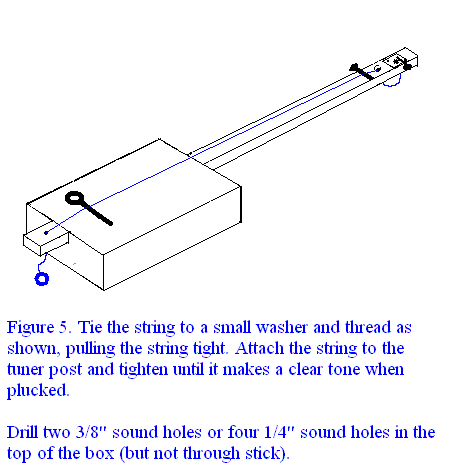
The diddley bow may have been the first instrument that produced the sound of sliding rhythm and the whines and cries of a single string that later became the distinctive sound known today as the "blues".  It was common to the rural south in the 1800's and was made by stretching a piece of broom or cotton wire around  two nails and a bottle or snuff can wedged under the wire to create tension for pitch. The string was plucked while sliding a piece of metal or glass on it to produce notes.


Cigar Box Diddley Bow


Simple Diddley Bow (with tuning heads)


Robert Johnson, B.B. King, Muddy Waters, Albert King, "One-String'' Jones, Jesse Mae Hemphill, Elmore James, Pinetop Perkins, Lightnin' Hopkins, Son House, Charlie Patton, John Lee Hooker, Big Bill Broonzy, Mississippi John Hurt, Jimmy Reed, Luther Allison and Lonnie Pitchford are a few of the blues people that have played diddley bows.

As stringed instruments evolve especially under electrification, expect this topic to be revisted many-a-time. :-R 


Robert Johnson Diddley Bow (with string removed)


Back To The Future: Clan Analogue

As a response to the lack of live venues for Electronic Music in Australia, electronic artists have transformed themselves and their music.

Clan Analogue is collective that defies the barriers. :-R

The following article is reposted from Clan Analogue with additional videos from YouTube.


History

Clan Analogue was started in Sydney, Australia, in 1992 as a collective by founder Brendan J Palmer, and a small group of people who were interested and active in electronic sound. Largely fuelled by the sore lack of live venues in Australia for electronic music and a lack of options for releasing recorded material, Clan Analogue was born out of necessity.
Since its inception Clan Analogue has released over 30 albums[1] directly with many more releases coming from collective members such as Deep Child, b(if)tekDisco StuArtificialDark NetworkAtone or the Telemetry Orchestra through other labels.
Clan Analogue's Gear Shift Jam Session for March 2012

Philosophy

"Following the digitalised simulation of the early analogue instruments throughout the nineties, Scot Art (aka Nerve Agent) informs me that analogue is ‘a process or a state of being’, apparently not distant from the idea of a collective, or a network of circuit paths. According to Scot, ‘a single transistor alone can only do so much … it needs a circuit, other transistors, to operate’. Not ‘digital creatures’, humans ‘are analogue wetware, a chemical-electrical circuit that exists in a network (society, nature) that allows these circuits to connect … to “oscillate” or otherwise display behaviour in accordance to … electro-magnetic theory’. As a social circuit board, Clan enables the building of networks by providing members with access to equipment, knowledge and advice, along with the opportunity to play live and co-produce music."[2]


Associated Artists and DJs


'Plug-In and Switch On' (Documntary Trailer): Clan Analogue


Releases

  • CA039K: THE TRUTH IN ME Koshowko [6]
  • CA038: RE COGNITION - THE CLAN ANALOGUE LEGACY COLLECTION Various Artists
  • CA037: DOUBLE EXPOSURE Winduptoys
  • CA037A: SWITCH ON Winduptoys
  • CA036K: PROMISE Koshowko[7]
  • CA036B: INVERTED – FURTHER DUB SELECTIONS Various Artists
  • CA036: IN VERSION Various Artists
  • CA036A: OVER AND OVER DUB Dsico
  • CA035: FLOPPY DISCO Bleepin' J. Squawkins
  • CA034: DOPPLER SHIFT Various Artists
  • CA033: LATE SET Dark Network
  • CA032: DEFOCUS: LOW RES PRODUCTIONS Various Artists
  • CA031: ANY NUMBER CAN PLAY Pretty Boy Crossover
  • CA030: HABITAT Various Artists
  • CA029: AN ENGLISHMAN IN IBIZA Disco Stu
  • CA028: COGNITION 4 – SOLID GOLD Various Artists
  • CA027: PEAR SHAPED Pear Shaped / Atone
  • CA026: HYMNS FROM BABYLON Deepchild
  • CA025: COGNITION 3 Various Artists
  • CA024: BUTTSQUEEZER 5000 Fingers of Dr T
  • CA023: G-TYPE Nerve Agent
  • CA022: ADULT THEMES Disco Stu
  • CA021: PRE-SENSE : A CONVERGENCE OF SOUTHERN HARMONIC WAVES Various Artists
  • CA020: COGNITION 2: TWENTY DISCO GREATS Various Artists
  • CA019: LIVE BETTER ELECTRICALLY Telemetry Orchestra
  • CA017: JAUNT 2 Various Artists
  • CA016: ORANGE CHROME 5000 Fingers of Dr T
  • CA015: CRUCIFIED, STITCHED UP AND THEN SOME Atone
  • CA014: COGNITION Various Artists
  • CA012: JAUNT Various Artists
  • CA011: APHELION ONE Various Artists
  • CA007: COG Various Artists
  • CA004: EP4 Various Artists
  • CA003: Deep Three EP Various Artists
  • CA002: EP2 Various Artists
  • CA001: EP1 Various Artists

Saturday, March 24, 2012

Turning the Clock Back: Kitty, Daisy and Lewis

The following article is from the more recent UK archives but displays the forgotten wonders of the analogue world.

Particularly of note is Kitty, Daisy and Lewis' dedication to using all analogue tools in recording their music.  It's borne out in their post-retro rockabilly style that is so popular here in Sydney, NSW.

I'll follow with a re-post of their acoustic performance for 'Studio 11' in Melbourne in 2012. :-R

ANALOG exhibition traces London’s darkrooms

Published on 4. 1. 2011 at 3:01 pm

The impact of digital technology on print photography and music production is the subject of ANALOG at Riflemaker in London’s Soho, from 10 January 2011.
The exhibition invites us inside the last of London’s photographic darkrooms, as well as taking a visit to a working reel-to-reel music studio, courtesy of an installation by Lewis Durham of the band Kitty, Daisy & Lewis.

In 2007, when Richard Nicholson began photographing London’s professional darkrooms, there were some 204 still in existence. When he completed the project three years later, only 8 remained. In these labs many of the iconic images of 20th-century culture were processed, from the high-contrast b/w prints of the cast of Trainspotting to lith portrait album covers for U2. Analogue aficionado Lewis Durham’s reel-to-reel recording studio, to be installed at Riflemaker, includes equipment from the legendary Atlantic Studios in Muscle Shoals (Aretha Franklin, Ray Charles), along with Elvis Presley’s New York RCA Studios equipment.


The exhibition will also include familiar contemporary objects like laptops and mobile phones sculpted in cardboard by artist Clare Mitten who ‘re-analogues’ them, turning today’s pods back to analogue. In complete contrast, a massive interactive, computational light installation will be installed in the galllery by Zigelbaum + Coelho, winners of the prestigious Designer’s of the Future award at Miami/Basel Design 2010. Z+C have taken the humble pixel from its on-screen habitat and placed it on the wall, ie back in the physical world. The visitor will therefore experience a unique interactive digital/analogue mix.

Photographer Richard Nicholson began to shoot images of professional photographic darkrooms in and around London in 2006. At that time the darkrooms formed the engine of the British photographic industry.

Many of the iconic images of recent decades were made by so-called ‘master printers’ in the rooms pictured. These include Mike Spry’s high-contrast lith prints of U2 and Depeche Mode for music photographer Anton Corbijn, Peter Guest’s black-and-white prints of the Trainspotting cast for portrait photographer Lorenzo Agius and Brian Dowling’s intricately masked colour prints for fashion photographer Nick Knight.

Richard Nicholson said: ‘The spaces I discovered were often haphazard and brimming with personal details: coffee cups, CD collections, family snaps, unpaid invoices, curious knick-knacks brought back by globe-trotting photographers. These human elements transformed what might have been a detached typology of modernist industrial design into something more intimate and nuanced.’


Nick Cave and the Bad Seeds and The White Stripes have famously chosen to record on analogue equipment but they are notable as exceptions in the digital takeover. Similarly Kitty, Daisy & Lewis is a young band that prefers the process and warmth of sound achieved through analogue recordings. The much-signalled death of vinyl has long been held back by DJ culture and in fact sales of vinyl recordings have increased by 20% year on year since 2005.

Kitty, Daisy and Lewis and special guests will perform at Riflemaker during the course of the exhibition, as well as recording all-comers ‘direct to disc’ in the gallery’s pop-up music lounge. Follow Riflemaker on Twitter to find out how to be part of the audience http://www.twitter.com/riflemaker_soho

Visitor information: ANALOG: 10 January to 3 March 2011
Riflemaker 79 Beak Street, London W1
Telephone: 020 7439 0000
www.riflemaker.org
www.richardnicholson.com
www.kittydaisyandlewis.com
www.zigelbaumcoelho.com


Kitty, Daisy and Lewis live performances from their 2011 album 'Smoking in Heaven' :

Buggin' Blues


Smoking in Heaven